
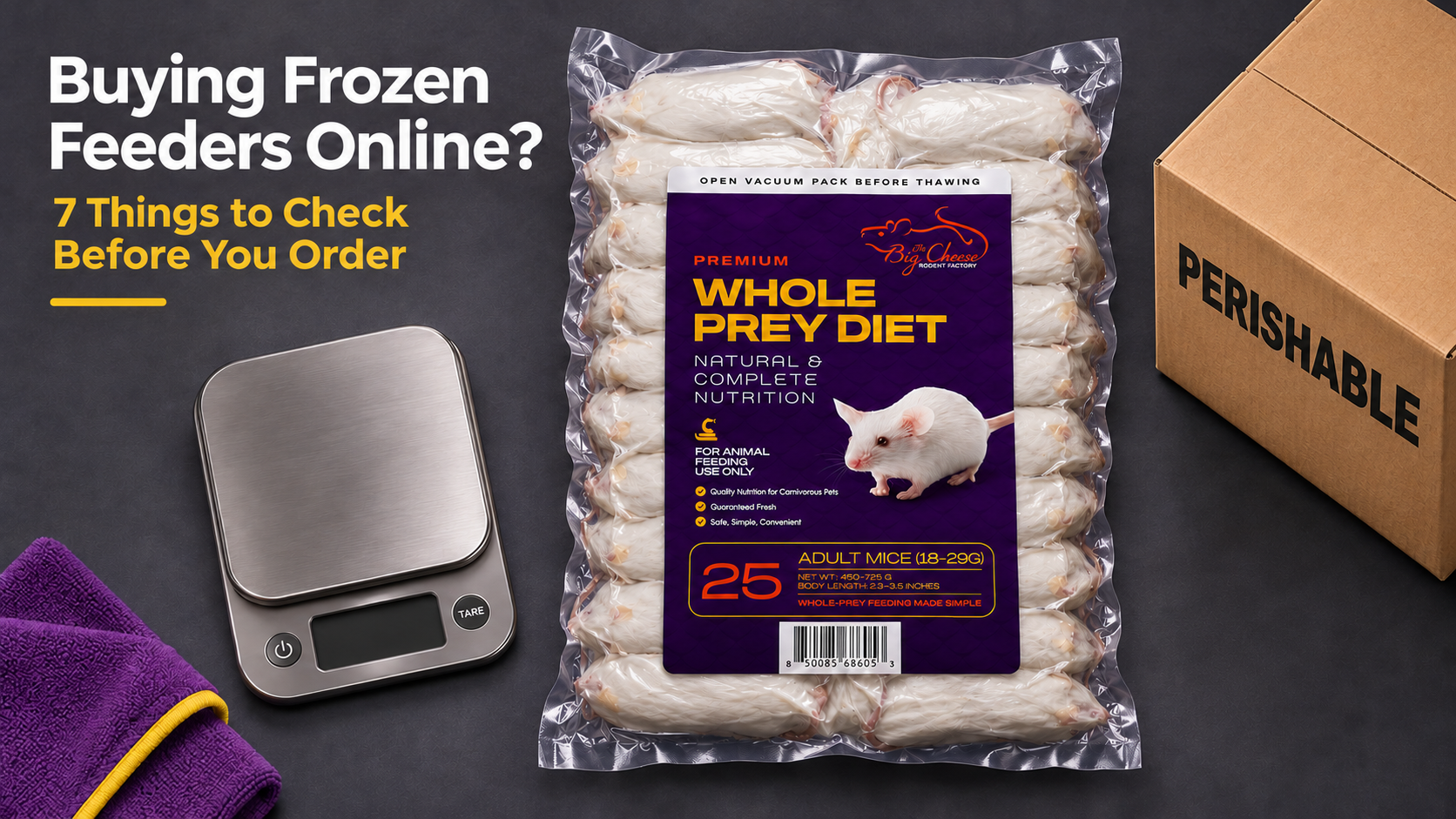
Buying frozen mice and rats online starts with choosing the right feeder size, but there are other details worth checking before you place an order. Package quantities, shipping costs, packaging, and delivery policies all affect what you receive—and what you pay.
Whether you’re feeding one snake or stocking a freezer for a collection, these seven checks can help you choose a supplier and order with confidence.
1. Check Feeder Weights, Not Just Size Names
Names such as “pinky,” “fuzzy,” “small,” and “large” are useful starting points, but size labels alone don’t tell you the weight of the feeder you’re buying.
Look for a weight range in grams. When comparing products, check the listed weights rather than assuming similarly named feeders are equivalent.
Choose prey appropriate for your animal’s species, size, and individual needs. If you’re unsure, consult a species-specific care resource or a reptile veterinarian before changing feeder sizes.
At The Big Cheese Rodent Factory, check the weight information for your selected product before adding it to your cart. You can also explore our feeding and size guides to help narrow your options.
2. Confirm How Many Feeders Are in Each Package
The package price only tells part of the story. You also need to know how many individual mice or rats it includes.
For example, a hypothetical $30 package containing 25 feeders costs $1.20 per feeder. A $40 package containing 50 feeders costs $0.80 per feeder. That comparison is useful only if the feeders are comparable in size and weight.
Before ordering, confirm:
- How many feeders are in each package?
- Whether the price shown is per feeder or per package?
- How many packages are in your cart?
- Whether you have enough freezer space.
Compare equivalent products by both weight and quantity.
3. Look at How the Feeders Are Packaged
One of the most frequent questions we receive is whether the process alters the dietary integrity of whole prey.
The short answer is “NO”, at least not in any meaningful way.
Decades of peer-reviewed research confirm that core proteins, essential fats, amino acids, and macronutrients remain completely intact after undergoing irradiation. Any negligible nutrient losses are entirely comparable to the minor variations that occur during standard freezing or conventional cooking.
Likewise, the process does not alter the natural appearance, physical texture, or palatability of the frozen whole prey, ensuring seamless feeding acceptance.The best packaging keeps air out. Vacuum-sealed bags help protect feeders from freezer burn, which matters most when you buy several feedings at once.
Ask the supplier how its feeders are packed and how to store the rest after you open a bag.
At Big Cheese, our frozen mice and rats are packed in Cryovac® vacuum-sealed bags. Removing excess air helps protect against freezer burn during frozen storage. Once you open a package, protect the remaining feeders from air exposure and keep them frozen.
Occasionally, a vacuum seal can loosen during transportation. A loose seal alone does not establish that the contents have thawed or been damaged; inspect the products and contact us if you have concerns.
4. Compare the Total Delivered Cost
The lowest advertised feeder price may not produce the lowest order total.
Include shipping when comparing suppliers. Check applicable discounts, taxes, and the final checkout total, too.
A useful calculation is:
Delivered cost per feeder = total order cost ÷ total number of feeders
Use the delivered cost per feeder: your total order cost, including shipping, discounts, and tax, divided by the total number of feeders. The lowest advertised price doesn’t always give the lowest final total. For mixed-size orders, price the same basket of products at each supplier.
Big Cheese currently offers free standard shipping on orders of $129 or more and $29 flat-rate shipping on orders under $129. Check your final checkout total before submitting your order.
5. Review Shipping Days and Plan for Delivery
The day you order and the day your order ships may differ. Check the supplier’s shipping days, order cutoff times, and estimated transit time before you buy.
Big Cheese ships Monday through Wednesday, packed with insulation and dry ice. Some larger orders headed to extended-transit areas may be held for Monday shipment to avoid weekend delays. See our current shipping schedule when planning your order.
Check our current shipping schedule when planning your order.
When your order is on its way:
- Track the shipment.
- Bring the package inside as soon as it arrives.
- Inspect the contents.
- Move the feeders into your freezer right away.
6. Read the Frozen-Arrival Guarantee
A frozen-arrival guarantee explains what the supplier does if perishable feeders arrive in poor condition. Read it before you order so you know the rules.
Look for clear answers to these questions:
- What arrival conditions are covered?
- How soon must you report a problem?
- Are photos required?
- Is the fix a replacement, a credit, or a refund?
- What are you responsible for after delivery?
Big Cheese offers a Frozen Arrival Guarantee, subject to our published terms:
- Report shipment issues within three days of delivery.
- Provide photographs.
- Keep the products and packaging until we tell you otherwise.
Approved remedies may include replacement products or store credit. Prompt retrieval and proper storage are required; thawing caused by leaving a delivery outside or unopened for an extended period is not covered. Read our full guarantee and return policy before ordering.
7. Make Sure You Can Reach the Supplier
A reliable supplier makes it easy to reach them before you need help. Look for a working phone number, an email address, and clearly written policies.
If you’re unsure about pack quantities, feeder weights, or shipping, ask before you place your order.
You can reach The Big Cheese Rodent Factory at 817-926-3300 or info@bigcheeserodents.com with product and order questions.
Frequently Asked Questions
How do I know what size frozen mouse to feed my snake?
Choose by weight in grams, matched to your snake’s species, size, and individual needs. Size names like “pinky” or “small” vary between suppliers. If you’re unsure, ask a reptile veterinarian or check a species-specific care guide.
What is the cheapest way to buy frozen mice online?
Compare the delivered cost per feeder: total order cost, including shipping and tax, divided by the number of feeders. At Big Cheese, orders of $129 or more ship free, while orders under $129 have a $29 flat shipping rate.
How are frozen feeders shipped?
Big Cheese ships Monday through Wednesday in insulated packaging with dry ice. Some larger orders to extended-transit areas may be held for Monday shipment to avoid weekend delays.
What should I do when my frozen feeders arrive?
Bring the package inside promptly, inspect the contents, and move the feeders into your freezer right away. If there’s a problem, report it to Big Cheese within three days of delivery, with photos.
Does a loose vacuum seal mean my feeders thawed?
No. A loose seal alone doesn’t show the feeders thawed or were damaged. Inspect the products and contact the supplier if you have concerns.
How should I store frozen mice after opening the bag?
Keep the remaining feeders frozen and protected from air exposure to help prevent freezer burn.
Ready to Choose Your Frozen Feeders?
A good purchasing decision brings together the right feeder size, clear quantities, suitable packaging, transparent delivery costs, and dependable support.
At The Big Cheese Rodent Factory, we make those details available so you can choose an order that fits your animals and your budget.
Shop frozen mice, rats, and other feeders at Big Cheese, or contact us with questions before you order.
Leave a Reply